
Allegory of Peace and War
Pompeo Girolamo Batoni · 1776
Provenance
Ownership history
- In the artist’s studio from 1776 until at least January of 1781 [for early mentions of the picture including those in letters of Father John Thorpe to Lord Arundel, see Bowron 2016, pp. 518-20]. Probably Comtesse Clotilde Eugénie d’Oultremont (née van den Steen de Jehay, 1850–1932); by descent to her daughter Elisabeth von Furstenberg (née d’Oultremont, died 1953), Brussels; by descent to her son Maximilien, Cardinal von Furstenberg (died 1988), Brussels, Lisbon, and Vatican City; by descent to his nephew Comte Wenemar de Furstenberg, Belgium [see copy of Cardinal von Fürstenberg’s note of June 5, 1977, listing paintings bequeathed to Comte Wenemar de Furstenberg, and the count’s letter to Jean-François Heim, dated March 27, 1998, in object file]; sold through Jean-François Heim, Paris, to the Art Institute, 1998.
Recorded by Art Institute of Chicago.
Exhibitions
Exhibition history
- Houston, Museum of Fine Arts, Pompeo Batoni: Prince of Painters in Eighteenth-century Rome, October 21, 2007-January 27, 2008, cat. 71; National Gallery, London, February 20-May 18, 2008 [Houston only].
Literature
Published references
- Onofrio Boni, Elogio di Pompeo Girolamo Batoni (Rome: Stamperia Pagliarini, 1787), pp. 55, 68.
- T. Trenta, “Notizie di pittori, scultori e architetti lucchesi,” in Memorie e documenti per servire all’istoria del Ducato di Lucca, VIII, 1822, p. 173.
- Gaudenzio Claretta, I Reali di Savoia Munifici Fautori delle Arti: Contributo alla Storia Artistica del Piemonte del Secolo XVIII. (Turin: Stamperia Reale della Ditta G. B. Paravia E C., 1893), pp. 229–30.
- Ernst Emmerling, Pompeo Batoni: sein Leben und Werk (Darmstadt: Gesellschaft Hessischer Bücherfreunde, 1932), p. 129, no. 176.
- Isa Belli Barsali, “Pompeo Gerolamo Batoni (1708–1787),” La Provincia di Lucca, vol. 4 (January-March 1964), pp. 75–76, 80 nn. 22 and 23.
- Ein Potsdamer Maler in Rom: Briefe des Batoni-Schülers Johann Gottlieb Puhlmann aus den Jahren 1774 bis 1787, ed. Götz Eckardt (Berlin: Henschelverlag, 1979), pp. 121, 145, 274-75.
- Anthony M. Clark, Pompeo Batoni: A Complete Catalogue of His Work with an Introductory Text, ed. Edgar Peters Bowron (Oxford: Phaidon, 1985), p. 369.
- Art in Rome in the Eighteenth Century, ex. cat., eds. Edgar Peters Bowron and Joseph J. Rishel (Philadelphia: Philadelphia Museum of Art, 2000), p. 320.
- Edgar Peters Bowron, “Pompeo Batoni’s ‘Allegory of Peace and War’ and Other Subject Pictures,” in Studi di Storia dell’Arte in Onore di Denis Mahon, eds. Maria Grazia Bernardini, Silvia Danesi Squarzina, and Claudio Strinati (Milan: Electa, 2000), pp. 359–60, fig. 4.
- John Gedo, “Pompeo Batoni’s Allegory of Peace and War,” Burlington Magazine 144 (2002), pp. 601-606, fig. 10.
- Larry J. Feinberg, “A Brief History of the Old Masters in the Art Institute of Chicago, Museum Studies 32, 2 (2006), p. 21, fig. 16.
- Edgar Peters Bowron and Peter Björn Kerber, Pompeo Batoni: Prince of Painters in Eighteenth-Century Rome, ex. cat., Museum of Fine Arts, Houston (New Haven: Yale University Press, 2007), pp. 90, 138-40, 166, 170, 176, 180, 202, 206 n. 91, no. 71, fig. 122.
Comparables
Related holdings by the same hand
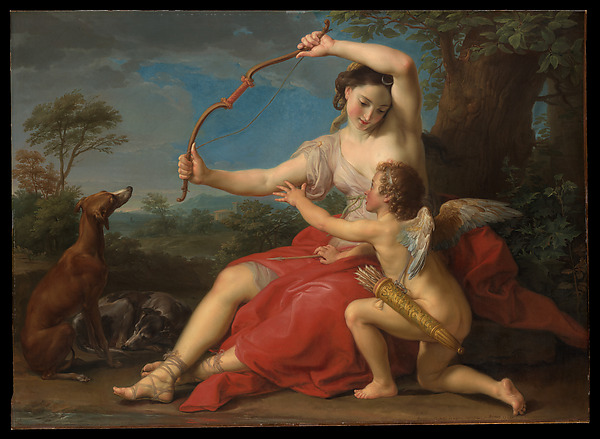
Diana and Cupid
The Metropolitan Museum of Art
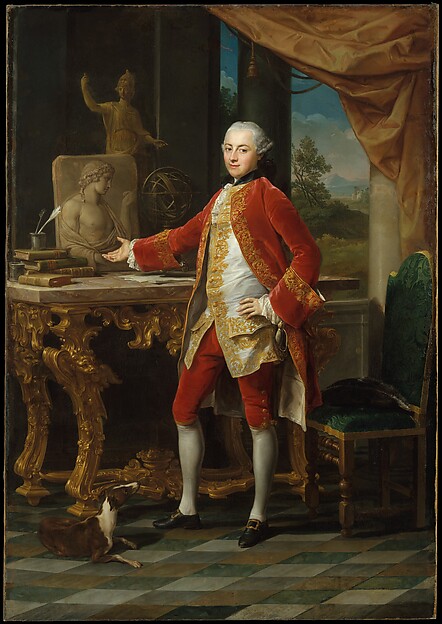
Portrait of a Young Man
The Metropolitan Museum of Art
Bust-Length Study of a Child
The Metropolitan Museum of Art

Allegory in Honor of Pope Benedict XIV
The Metropolitan Museum of Art

Three Nude Male Figures; Study of the Right Hand of the Figure on the Left
The Metropolitan Museum of Art

Portrait of Cavaliere Pompeo Batoni
The Metropolitan Museum of Art
Allegorical Figure Representing Geometry
The Metropolitan Museum of Art
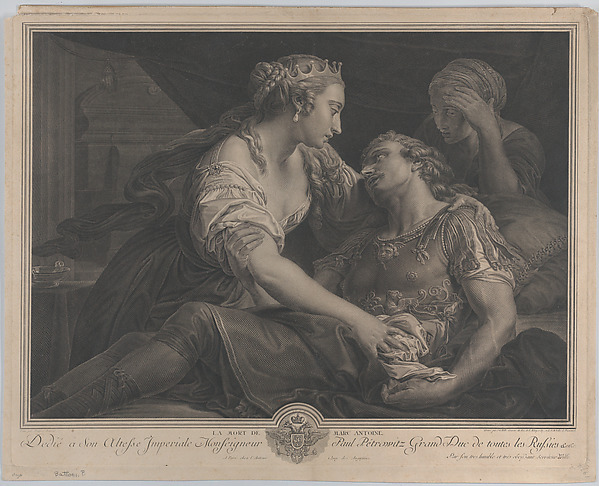
The Death of Mark Antony with Cleopatra at left
The Metropolitan Museum of Art
Museum holdings, not sale records. Auction results are only shown when a licensed price source is connected.
Research assistant